Call Us Today at 877-410-7665 Serving North & Central Florida

Get Informed withLatest News & Tips
Get Started with a Free Consultation
Start Your Filters! Spring is Here!
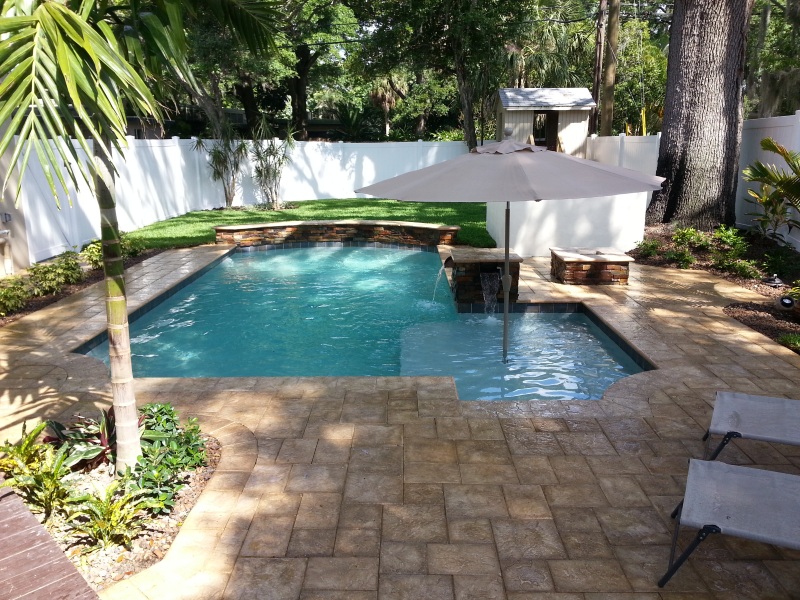
The warmer (ok, hot) weather will be soon here and that means a lot more time spent in the swimming pool. So before you ramp up use as the temperatures continue to rise, it is important that you follow these pool ownership tips to ensure the health and safety of your pool and its occupants.
Check the Swimming Pool Water Levels
Your water level should be halfway up the tile or around the middle of your skimmer opening. If you need to top your water off, get that garden hose working and fill up your pool.
Test the Chemistry of Your Pool
Run the circulation system for 24 hours or so before you test the chemistry of your pool. Your pool should be within the following ranges:
- Total Alkalinity (TA) – 80 to 120ppm
- pH – 7.4 to 7.6
- Chlorine – 2.0 to 4.0ppm
Adjust Your Chemistry as Necessary
You can largely control the levels of pH and chlorine in your pool by first adjusting its TA.
- If your TA is too high, you can use dry acid (sodium bisulfate) to reduce levels to an acceptable range
- If your TA is too low, you can use sodium bicarbonate to increase it
You should wait at least 4 hours (or however it is otherwise recommended on the packaging label) after adding to retest your pool water.
Tackle the pH Balance and Calcium Hardness
When your TA is between 80 to 120ppm, you can begin adjusting your pH levels as necessary.
- If your pH is above 7.6, try adding dry acid (sodium bisulfate) or muriatic acid
- If your pH is below 7.2 use soda ash to bring it back to acceptable levels
Wait at least 4 hours for the pH level to settle. You can then test and adjust your calcium hardness so that it is above 150ppm. Calcium chloride can be used to increase the calcium hardness which will prevent pitting in your concrete, plaster and pebble tec.
Brush, Vacuum, and Filter
Once the chemistry has been adjusted, give your pool walls, floor, steps, ladders and other equipment a good brush down. Re-attach any other items which you may have removed (such as slides, basketball hoops, etc.). Vacuum the pool and run your filtration system overnight to eliminate any dirt, bacteria, debris and algae that may still be present.
Shock Your Pool
Whenever you add chlorine to your pool water, the chlorine molecules naturally attach themselves to algae, debris and other unwanted material. This forms what is known as a chloramine.
This “dead chlorine” should be removed from your pool. This is why it is usually recommended that you shock your pool before it really starts to heat up so your swimming pool will be ready for increased usage.
Follow these pool ownership tips to get your spring off to a good start. The better you take care of your pool now, the less maintenance and service you’ll need later.
About All Seasons Pools
All Seasons Pools has been a trusted pool expert for Orlando, St.Augustine, Jacksonville, The Villages and other Atlantic coast communities since 1979. Started by John and Diane Watts, they specialize in creating amazing and unique backyard retreats for families to enjoy, including top-of-the-line custom pools and amazing outdoor living areas. They work hard to fulfill their motto to “leave every customer with a smile.”
As members of the Association of Pool & Spa Professions and Florida Swimming Pool Association, they put a strong emphasis on being strong, reliable builders and staying up-to-date on the latest pool industry technology and design trends. Visit their swimming pool gallery to see pools ranging from signature and geometric designs to natural forms.
Are you ready to get started on your Florida backyard getaway? Design your pool with our interactive guide and schedule your free consultation today!
For more pool maintenance and outdoor living tips, you can subscribe to All Seasons Pools’ blog and follow them on Facebook, Twitter, Pinterest and Google +.